Your on-line source for reliable and unbiased information about the evaluation & treatment of heart disease.
When is a Regular Stress Test ordered?
How is a Treadmill Stress Test performed?
Preparing for the test?
How safe is it?
What is the reliability of the test?
How quickly will I get the results?
How does a Regular Stress Test Work? Patients with coronary artery blockages may have minimal symptoms and an unremarkable or unchanged EKG while at rest. However, symptoms and signs of heart disease may become unmasked by exposing the heart to the stress of exercise. During exercise, healthy coronary arteries dilate (develop a more open channel) than an artery that has a blockage. This unequal dilation causes more blood to be delivered to heart muscle supplied by the normal artery. In contrast, narrowed arteries end up supplying reduced flow to it's area of distribution. This reduced flow causes the involved muscle to "starve" during exercise. The "starvation" may produce symptoms (like chest discomfort or inappropriate shortness of breath), and the EKG may produce characteristic abnormalities. Most commonly, a motorized treadmill is used for exercise, while a stationary bicycle is used in some exercise laboratories.
When is a Regular Stress Test ordered? A regular stress test is considered in the following circumstances:
- Patients with symptoms or signs that are suggestive of coronary artery diseases (CAD).
- Patients with significant risk factors for CAD.
- To evaluate exercise tolerance when patients have unexplained fatigue and shortness of breath.
- To evaluate blood pressure response to exercise in patients with borderline hypertension.
- To look for exercise-induced serious irregular heart beats.
Please remember that the regular stress test is heavily dependent upon interpretation of EKG changes produced by exercise. Therefore, the reliability drops drastically if there are significant EKG changes at rest (for example in patients with long standing high blood pressure, an artificial cardiac pacemaker, use of medications like digitalis, or presence of a bundle branch block pattern, etc.). In all such cases, the physician will usually order an Echo Stress Test or a Nuclear Stress Test, particularly if he or she is suspecting coronary artery disease. However, a regular stress may be sufficient in stable patients or those with a low suspicion of coronary artery disease who are being assessed for exercise tolerance (for example, prior to undergoing a structured exercise or rehab program).
How is a Regular Treadmill Stress Test Performed? The patient is brought to the exercise laboratory where the heart rate and blood pressure are recorded at rest. Sticky electrodes are attached to the chest, shoulders and hips and connected to the EKG portion of the Stress test machine. A 12-lead EKG is recorded on paper. Each lead of the EKG represents a different portion of the heart, with adjacent leads representing a single wall. For example:
- Leads 2, 3, and aVF = bottom or inferior portion of the heart.
- Leads V1 and V2 = septum or partition of the heart.
- Leads V3, V4, V5 and V6 = anterior or front portion of the heart.
- Leads 1 and aVL = superior or top and outer left portion of the heart.
- Lead aVR looks at the cavity of the heart and has almost no clinical value in identifying coronary disease.

Three of the EKG leads are also constantly displayed on the treadmill monitor. Each lead representing a different wall. The physician has the option of selecting different combinations of three.
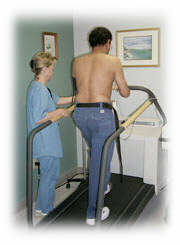 The treadmill is then started at a relatively slow "warm-up" speed. The treadmill speed and it's slope or inclination are increased every three minutes according to a preprogrammed protocol (Bruce is the commonest protocol in the USA, but several other protocols are perfectly acceptable). The protocol dictates the precise speed and slope. Each three minute interval is known as a Stage (Stage 1, Stage 2, Stage 3, etc. Thus a patient completing Stage 3 has exercised for 3 x 3 = 9 minutes). The patient's blood pressure is usually recorded during the second minute of each Stage. However, it may be recorded more frequently if the readings are too high or too low.
As noted earlier, the EKG is constantly displayed on the monitor. It is also recorded on paper at one minute intervals. The physician pays particular attention to the heart rate, blood pressure, changes in the EKG pattern, irregular heart rhythm, and the patient's appearance and symptoms. The treadmill is stopped when the patient achieves a target heart rate (this is 85% of the maximal heart rate predicted for the patient's age). However, if the patient is doing extremely well at peak exercise, the treadmill test may be continued further. The test may be stopped prior to achievement of the target heart rate if the patient develops significant chest discomfort, shortness of breath, dizziness, unsteady gait, etc., or if the EKG shows alarming changes or serious irregular heart beats. It may also be stopped if the blood pressure (BP) rises or falls beyond acceptable limits. Please note that the systolic BP (upper number) may normally rise to 200 at peak exercise. At the same time, the diastolic BP (lower number) remains unchanged or falls to a slight degree. In contrast, the BP of patients with hypertension or high BP will show a rise of both systolic and diastolic readings. The latter may rise above 90 - 100.
Preparing for the Regular Stress Test:
The following recommendations are "generic" for all types of cardiac stress tests:
- Do not eat or drink for three hours prior to the procedure. This reduces the likelihood of nausea that may accompany strenuous exercise after a heavy meal. Diabetics, particularly those who use insulin, will need special instructions from the physician's office.
- Specific heart medicines may need to be stopped one or two days prior to the test. Such instructions are generally provided when the test is scheduled.
- Wear comfortable clothing and shoes that are suitable for exercise.
- An explanation of the test is provided and the patient is asked to sign a consent form.
- How long does the entire test take? A patient should allow approximately one hour for the entire test, including the preparation.
How safe is a Regular Treadmill Stress Test? The risk of the stress portion of the test is very small and similar to what you would expect from any strenuous form of exercise (jogging in your neighborhood, running up a flight of stairs, etc.). As noted earlier, experienced medical staff is in attendance to manage the rare complications like sustained irregular heart beats, unrelieved chest pain or even a heart attack.
What is the reliability of a Regular Stress Test? If a patient is able to achieve the target heart rate, a regular treadmill stress test is capable of diagnosing important disease in approximately 67% or 2/3 rd of patients with coronary artery disease. The accuracy is lower (about 50%) when patients have narrowing in a single coronary artery or higher (greater than 80%) when all three major arteries are involved. Approximately 10% of patients may have a "false-positive" test (when the result is falsely abnormal in a patient without coronary artery disease).
How quickly will I get the results and what will it mean? The physician conducting the test will be able to give you the preliminary results before you leave the exercise laboratory. However, the official result may take a few days to complete. The results of the test may help confirm or rule out a diagnosis of heart disease. In patients with known coronary artery disease (prior heart attack, known coronary blockages, previous treatment with angioplasty, stents or bypass surgery, etc.), the study will help confirm that the patient is in a stable state, or that a new blockage is developing. The results may influence your physician's decision to change your treatment or recommend additional testing such as cardiac catheterization, Echo Stress test, or a nuclear stress test.

©1999-2017, 20XXA.S.M. Systems, Inc. All Rights Reserved, including design and all graphic contents & animations