Your on-line source for reliable and unbiased information about the evaluation & treatment of heart disease.
First | 1 | 2 | 3 | 4 | 5 | 6| Last
The Cardiac Cath learning module is made up of 6 parts or sections. You may navigate through the pages by clicking on the green arrows or numbers (above), the specific questions (below) or the gray menu items on the left.
What is Cardiac Catheterization?
What Preparations are Needed?
How is Cardiac Cath performed?
What do I need to know about the equipment?
What is experienced in the Cath lab?
How long does it take?
What preparations are needed?
What happens after arrival in the cath lab area?
How safe is the procedure?
What is the reliability of the test?
How quickly will I get the results?
Show me a panoramic view of the Cardiac cath lab?
What are the Commonest Access sites
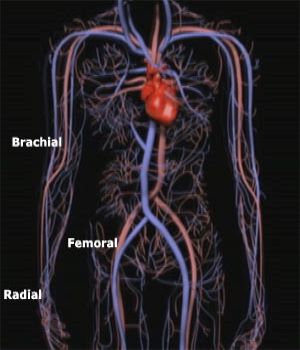
Cardiac Catheterization (Cath) is most commonly performed by inserting a thin flexible tube into the right femoral artery which is located under the skin, in the right groin. Occasionally the right or left arm (brachial artery) or wrist (radial artery)approach may be employed (as shown below). Step-by-step, we will now walk you through a cardiac cath procedure.
What Preparations are Needed?
Cath may be performed during a hospitalization (inpatient) or as an outpatient procedure, when the patient is admitted and discharged on the same day of the procedure.
If an outpatient procedure is planned, the following checklist needs to be followed:
- Pack a small overnight bag in case you need to spend the night in the hospital. Leave all valuables at home. Pack your contact lenses (with solution) and eye glasses if you wish to view the pictures during the procedure.
- If the procedure is scheduled prior to noon, do not eat or drink after midnight. Medications prescribed by your doctor may be taken with sips of water. If the procedure is scheduled for the afternoon, you may be allowed to have an early liquid breakfast (juice, tea, broth, water, etc.) prior to 7 a.m.
- Make certain that you have directions to the lab and the time that you are to report there. Call your doctor's office or the facility if you have any questions. Also, make sure that you receive instructions about eating, drinking, and the use of prescribed medications.
- Diabetic patients, particularly those on insulin, need clarification about the insulin dose and whether it will be used before or after the procedure.
- Make arrangements to have a family member or friend drive you home. There is a waiting area provided for their use.
- If you are given lab results and Electrocardiogram (EKG) by your doctor, please be sure to give them to the nurse when you arrive. Also, bring all your regular medicines (or at least a list) with you.
- The preparations are similar if you are already hospitalized on the day of the procedure.

What Happens After Arrival in the Cath Lab?
- You will check in at the admission desk
- If you have not had recent blood work or an EKG, they will be obtained by the nurse.
- You will receive instructions about the procedure and what is expected for the day. Your doctor or office staff may already have discussed the procedure, risks and indications with you. You will be asked to sign a consent form. Feel free to ask any questions.
- You will be questioned about your history, medications, and allergies. (If you have an allergy to iodine and shellfish, or have had prior problems during an x-ray procedure or cardiac cath, please be sure to notify the nurse.) You will then change into a hospital gown.
- Make sure that you empty your bladder before being taken to the cath lab.
- The nurse will check your pulse and blood pressure.
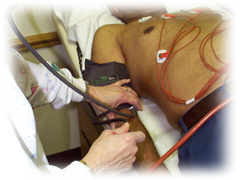
- The pulse area on your arm or leg may be marked with a felt-tip pen.
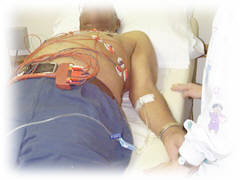
- An Intravenous (IV) will be started in your arm with the use of a small needle or plastic tube. This will allow the administration of fluids and medications.
- You may be given medicines (by mouth or IV) to help you relax.
- When preparations are complete and the cath lab is ready, you will be transferred there.
Shaving of the Groin
In the majority of cases, catheters are introduced through a tiny needle hole in the right groin. In such cases both groins are shaved in preparation for the procedure, on the outside chance that the other groin may have to be used. The movie (below, left) demonstrates this process. Click on the play button to view this, and the subsequent movies.
Transfer to the Cath Table
Patient being transferred on to the Cath table
The patient is then transferred from the stretcher to the Cath table The Cath Lab technologists (Techs) and nurses help reassure the patient and explain the various things that the patient will experience.
Scrubbing the Groin
Scrubbing of the groin areas
Use of Sterile Drapes
Patient being covered with sterile drapes
The patient is covered with sterile drapes from the neck down . This is just another step in ensuring that the cath procedure remains sterile.



©1999-2017, 20XXA.S.M. Systems, Inc. All Rights Reserved, including design and all graphic contents & animations