Your on-line source for reliable and unbiased information about the evaluation & treatment of heart disease.
What is a Holter Monitor and what information does it provide?
Preparing for the test
How is it performed?
How long does it take?
How safe is it?
How quickly will I get the results?
What is Holter Monitor? A Holter monitor is a continuous tape recording of a patient's EKG for 24 hours. Since it can be worn during the patient's regular daily activities, it helps the physician correlate symptoms of dizziness, palpitations (a sensation of fast or irregular heart rhythm) or black outs. Since the recording covers 24 hours, on a continuous basis, Holter monitoring is much more likely to detect an abnormal heart rhythm when compared to the EKG which lasts less than a minute. It can also help evaluate the patient's EKG during episodes of chest pain, during which time there may be telltale changes to suggest ischemia (pronounced is-keem-ya) or reduced blood supply to the muscle of the left ventricle.
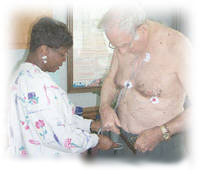
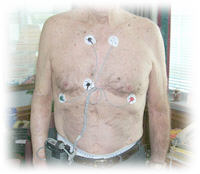

How do I prepare for the Test? The only requirement is that the patient wear loose-fitting clothes. Buttons down the front of a shirt or blouse is preferable. This makes it convenient to apply the EKG electrodes, and also comfortably carry the monitor in a relatively discreet manner
How is the Test Performed? The chest is cleansed with an alcohol solution to ensure good attachment of the sticky EKG electrodes. Men with hairy chest may require small areas to be shaved. The EKG electrodes (circular white patches on the left) are applied to the chest. Thin wires are then used to connect the electrodes to a small tape recorder. The tape recorder is secured to the patient's belt or it can be slung over the shoulder and neck with the use of a disposable pouch. The recorder is worn for 24 hours and the patient is encouraged to continue his or her daily activities. To avoid getting the setup wet and damaging the recorder, the patient will not be able to shower for the duration of the test. A diary or log is provided so that the patient can record activity (walking the dog, upset at neighbor, etc.) and symptoms (skipped heartbeats, chest discomfort, dizziness, etc.) together with the time. The Holter monitor has an internal clock which stamp the time on the EKG strips. These can be used to correlate the heart rhythm with symptoms or complaints. After 24 hours, the Holter monitor needs to be returned to the laboratory. This can be removed by the staff. However, if you live out of town or need to take a shower before leaving the house, the monitor can be disconnected from the electrodes and sent back to the laboratory, together with the completed diary.
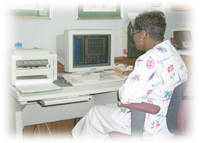
After returning the Holter Monitor to the doctor's office, satellite clinic or hospital lab, the tape is removed from the recorder and scanned by a technician. Multiple EKG strips are recorded on paper together with a computer-generated summary that provides details about the patient's heart rate and rhythm during the recording. This information is then provided to your doctor.
How long does it take? It takes approximately 10 to 15 minutes to apply the monitor and less than 5 minutes to remove it. The patient will also receive directions. Many monitors are also equipped with an "event" button. Pressing the button during a symptom (dizziness, for example) will help the technician print an ECG from that precise time.
How safe is the test? Holter monitoring is extremely safe and no different than carrying around a small tape recorder for 24 hours. Some patients are sensitive to the electrode adhesive, but no serious allergic reactions are known
When will I get the results? The report is provided to the physician, together with multiple EKG strips after the tape has been scanned by the technician. If the technician sees a rhythm that is life-threatening or potentially dangerous the physician is informed immediately. Otherwise, it may take a few days before you get the official results from your physician's office. At that time, you may also receive additional recommendations based upon the results of the test. For example, a pacemaker may be recommended if a patient has blackouts and the Holter monitor shows a seriously slow heart beat during the test.

©1999-2017, 20XXA.S.M. Systems, Inc. All Rights Reserved, including design and all graphic contents & animations